Skip to content
What Is Microencapsulated Sodium Butyrate? How Extended-Release Delivery Works
If you've been researching gut health supplements, you've probably come across sodium butyrate. It's one of the most studied postbiotic compounds in nutritional science — a short-chain fatty acid that your gut bacteria naturally produce to fuel the cells lining your colon.
But here's the problem most supplement companies don't tell you: standard sodium butyrate supplements are largely absorbed in the upper digestive tract, before they ever reach the colon where they're needed most.
That's where microencapsulated sodium butyrate changes the game. By wrapping each dose in a protective coating, micro-encapsulation technology delivers butyrate past the stomach and small intestine — directly to the colon, where it can actually do its job.
Why Standard Sodium Butyrate Falls Short
Sodium butyrate is naturally produced by beneficial bacteria in your large intestine. It serves as the primary energy source for colonocytes (the cells lining your colon) and plays a critical role in maintaining gut barrier integrity, regulating inflammation, and supporting immune function.
When you take a standard sodium butyrate capsule, most of it is absorbed in the small intestine — long before it reaches the colon. Research published in Frontiers in Nutrition confirms that "when supplemented orally, the majority of butyrate is absorbed in the small intestine, and relatively little butyrate reaches the colon."
This means standard supplements may provide some systemic benefits, but they're not efficiently delivering butyrate where your body needs it most: the large intestine.
There's also the practical issue of smell and taste. Butyric acid has a notoriously strong odor (think rancid butter), and standard capsules can produce unpleasant burps — a common complaint that leads many people to stop taking their supplement.
How Micro-Encapsulation Solves the Delivery Problem
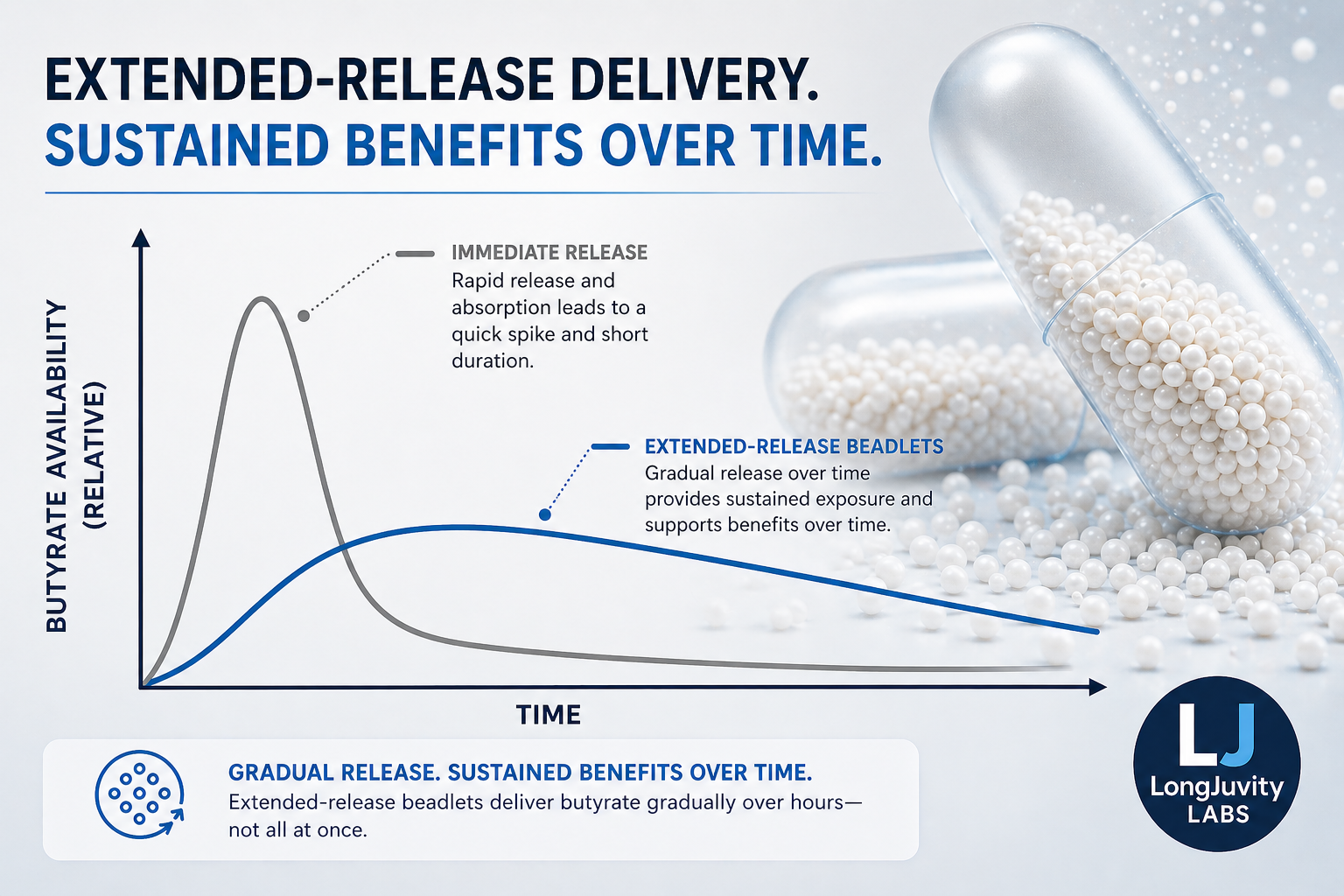
Microencapsulated sodium butyrate uses a protective matrix — typically a lipid or polymer coating — to shield the active butyrate from stomach acid and upper-intestinal absorption. The coating is designed to break down gradually as it moves through the digestive tract, releasing butyrate in a sustained, controlled manner.
The result is an extended-release delivery system that:
· Protects butyrate through the stomach, eliminating the unpleasant taste and odor
· Bypasses early absorption in the small intestine
· Delivers a significantly higher concentration of butyrate to the colon
· Provides sustained release over hours instead of a single rapid burst
A 2017 analysis of all oral sodium butyrate products on the market found that microencapsulated preparations achieved the highest butyrate concentration in the colon — delivering 35 to 50% of the dose to the large intestine, compared to significantly less from standard formulations.
5 Evidence-Backed Benefits of Microencapsulated Sodium Butyrate
1. Gut Barrier Support
Butyrate is the primary fuel source for the cells lining your colon. When these cells are well-nourished, they maintain tight junctions between each other — the physical barrier that prevents toxins, undigested food particles, and bacteria from entering your bloodstream. This is directly relevant to conditions associated with "leaky gut."
2. Digestive Comfort & IBS Symptom Relief
A large-scale clinical trial of nearly 3,000 IBS patients found that microencapsulated sodium butyrate significantly reduced abdominal pain, flatulence, diarrhea, constipation, and nausea (p < 0.001 across all measures). After 12 weeks, 93.9% of patients chose to continue therapy, and 88.9% said they would recommend it to other IBS sufferers.
3. Anti-Inflammatory Activity
Butyrate is one of the most potent natural anti-inflammatory compounds in the gut. It inhibits NF-κB signaling — a key driver of intestinal inflammation — and has been studied as supportive therapy for inflammatory bowel conditions. A 2025 review in Digestive Diseases and Sciences concluded that microencapsulated sodium butyrate preparations are "valuable therapeutic options supporting the treatment of intestinal diseases."
4. Immune System Modulation
Approximately 70% of your immune system resides in the gut. Research published in Microbiome (2025) demonstrated that butyrate-producing bacteria enhance immune defense by increasing lysozyme expression in colonic macrophages — your gut's first line of immune protection. Supplementing with butyrate directly supports this natural defense mechanism.
5. Microbiome Balance
Butyrate helps maintain an acidic pH in the colon, which favors the growth of beneficial bacteria while suppressing harmful pathogens. By feeding your colonocytes and supporting the right environment for a healthy microbiome, microencapsulated sodium butyrate works as a true postbiotic — providing the downstream benefits of a healthy microbiome even when your own bacterial production may be insufficient.
Microencapsulated vs. Standard vs. Tributyrin: How Do They Compare?
Not all butyrate supplements are created equal. Here's how the three main forms compare:
|
|
Microencapsulated SB |
Standard SB |
Tributyrin |
|
Colon delivery |
35–50% reaches colon |
Mostly absorbed in small intestine |
Moderate (requires enzymatic conversion) |
|
Release profile |
Sustained / extended-release |
Rapid burst |
Gradual (lipase-dependent) |
|
Smell & taste |
Minimal to none |
Strong butyric acid odor |
Moderate |
|
Clinical evidence |
Large-scale IBS trials (n=3,000) |
Limited human data |
Emerging (in-vitro promising) |
|
Form |
Postbiotic (direct butyrate) |
Postbiotic (direct butyrate) |
Precursor (converted to butyrate) |
The key takeaway: delivery technology matters as much as the active ingredient itself. The 2025 Springer Nature review put it clearly — "clinical outcomes may depend not only on the active ingredient but also on the delivery technology, release profile, and dosage."
What to Look for in a Microencapsulated Sodium Butyrate Supplement
Extended-release formulation — Look for micro-encapsulation or enteric coating that specifically targets colon delivery — not just a delayed-release capsule.
Adequate dosage — Clinical trials typically use 150–300mg of sodium butyrate per dose. Look for at least 300mg per capsule for meaningful therapeutic support.
Third-party testing — Lab-tested supplements ensure that the microencapsulation technology is actually working and the butyrate content matches the label.
No unnecessary fillers — The simpler the formulation, the better. You want sodium butyrate in a protective matrix — not a long list of additives.
Capsule count for sustained use — Benefits build over weeks of consistent use. A 120-capsule bottle at 2 capsules per day gives you a full 60-day supply.
Try LongJuvity's Microencapsulated Sodium Butyrate
LongJuvity's Sodium Butyrate supplement uses advanced micro-encapsulation technology to deliver 300mg of sodium butyrate per capsule in an extended-release formulation. Each bottle contains 120 capsules — a full 60-day supply at the recommended 2 capsules per day.
Our formulation is designed for targeted colon delivery, lab-tested for purity and potency, and free from unnecessary fillers. It's the same type of microencapsulated sodium butyrate technology that's been validated in clinical research with thousands of patients.
→ Shop Microencapsulated Sodium Butyrate
────────────────────────────────────────────────────────────
Sources
1. Banasiewicz T, et al. "The effectiveness of microencapsulated sodium butyrate at reducing symptoms in patients with irritable bowel syndrome." PMC, 2022.
2. "Use of Sodium Butyrate and Its Microencapsulated Forms in Intestinal Diseases—Current Clinical Approach." Digestive Diseases and Sciences, Springer Nature, 2025.
3. "Tributyrin (CoreBiome®) enhances butyrate levels and modulates the gut microbiota, barrier function, and immune response in vitro." Frontiers in Nutrition, 2025.
4. "Butyrate-producing commensal bacteria confers colon immune defense function via enhancing H4K31 Crotonylation of macrophages." Microbiome, Springer Nature, 2025.
- Posted in:
- Gut Health
- microencapsulated sodium butyrate